
Gujiya vs Karanji: Are They the Same Sweet? Differences, Ingredients & History
Gujiya vs karanji explained. Compare their fillings, regional traditions, festivals, names, history, and the key differences between these similar Indian sweets.
Latest Articles
 Wellness
What Is Avipattikar Churna? Ingredients, Traditional Uses and Safety
Oct 8, 2026
 Staples
Organic Honey vs Regular Honey: What the Label Covers and What It Doesn't
Oct 8, 2026
 Beauty
8 Best Natural Shampoos for Men to Buy Online in the USA, UK and Beyond
Oct 8, 2026
 Wellness
Best Ayurvedic Herbs for Sleep: 8 Herbs and the Forms They Come In
Sep 30, 2026
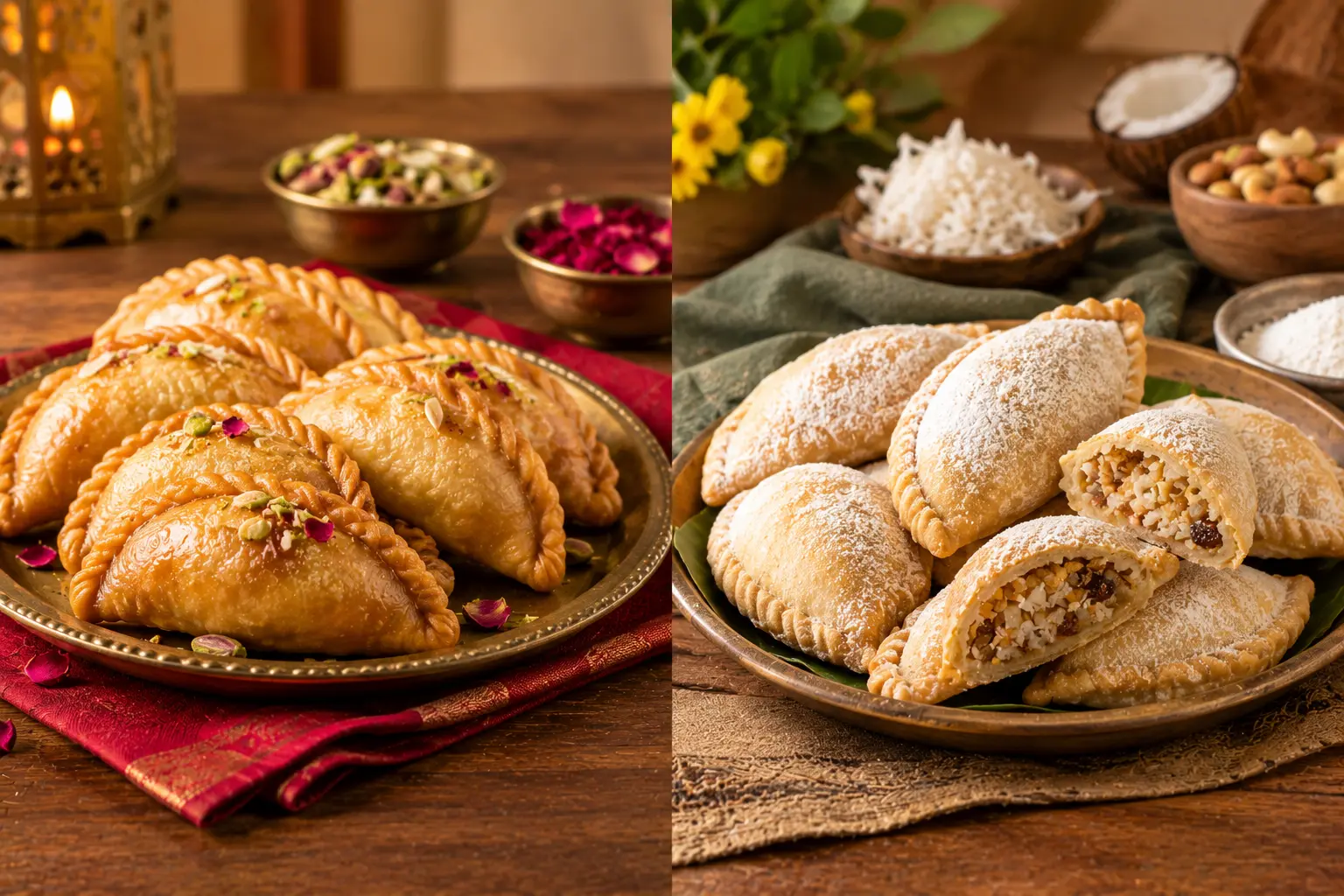
At first glance, gujiya and karanji look almost identical. Both are crescent-shaped sweets made with a pastry-like outer layer, filled, sealed at the edges, and fried until crisp.
The confusion makes sense because they belong to the same broad family of Indian festive sweets. Across the country, similar preparations appear under different names, with regional differences in fillings, ingredients, occasions, and preparation methods. Gujiya is particularly associated with Holi in North India, while karanji is closely associated with Diwali and other festivals in Maharashtra.
So, are gujiya and karanji the same thing? Not quite. They share the same basic format, but each has developed its own regional identity, flavors, and traditions.
If you've ever wondered why the same crescent-shaped sweet can be called gujiya in one place and karanji in another, or why a gujiya filled with khoya can taste so different from a coconut-filled karanji, you're not alone. The two sweets look remarkably similar, but their names, fillings, regional traditions, and festive associations tell a more interesting story.
We'll look at where gujiya and karanji come from, what typically goes into each one, how they differ across regions, and why both have earned their place in Indian festive food traditions.
What Is Gujiya?
Gujiya is a traditional Indian sweet made by filling a thin pastry dough with a sweet mixture, folding it into a crescent or half-moon shape, sealing the edges, and frying it until golden.
The classic North Indian version is usually filled with khoya or mawa (reduced milk solids), sugar, nuts, dried fruits, and cardamom. Depending on the region and recipe, the filling may also include coconut, semolina, jaggery (unrefined cane sugar), or other ingredients.
Gujiya is especially associated with Holi, the festival of colors, and is traditionally prepared in many North Indian households during the celebration. It is particularly popular in states such as Uttar Pradesh, Rajasthan, Madhya Pradesh, and Bihar.
You may also come across similar filled pastries under different regional names:
Gujiya or gujhiya: Common names in Hindi-speaking parts of North India
Pedakiya: A similar sweet pastry traditionally associated with Bihar
Ghughra: A related crescent-shaped sweet from Gujarat
Karanji: The Maharashtrian version, often made with a coconut and sugar filling
Nevri or Nevris: A Goan version, commonly filled with coconut and jaggery
Kajjikayalu or kajjikayi: A similar filled sweet found in parts of South India
Somas: A related fried pastry found in Tamil Nadu
These sweets are related rather than identical. They share the basic idea of a filled pastry that is folded and sealed, but the dough, filling, shape, cooking method, and cultural traditions can vary from one region to another.
What Is Karanji?
Karanji is a traditional Maharashtrian sweet made from thin pastry dough filled with a sweet mixture, folded into a crescent shape, and fried until crisp and golden.
A classic Maharashtrian filling often contains coconut, sugar or jaggery, cardamom, poppy seeds or sesame seeds, and nuts. Depending on the recipe, you may also find khoya or mawa (reduced milk solids), saffron, raisins, or other dried fruits.
Karanji is particularly associated with Diwali (the festival of lights) in Maharashtra. It is part of the traditional festive spread known as faral (a selection of homemade savory and sweet snacks prepared for Diwali). Karanji is also prepared for other celebrations, including Ganesh Chaturthi.
According to the Maharashtra Tourism Department, karanji is a traditional Maharashtrian delicacy made with fillings that can include coconut, jaggery, sesame seeds, nuts, raisins, cardamom, nutmeg, sugar, and ghee (clarified butter).
While the basic idea is similar to gujiya, the filling and festive traditions give karanji its own regional identity. That difference is especially noticeable when you compare the Maharashtrian version with the North Indian gujiya.
Gujiya and Karanji Difference at a Glance
Feature | Gujiya | Karanji |
Strongest regional association | North India | Maharashtra |
Common festival | Holi | Diwali |
Shape | Crescent or half-moon | Crescent or half-moon |
Outer layer | Usually flour-based | Usually flour-based |
Common filling | Khoya, sugar, nuts, dried fruits | Coconut, sugar or jaggery, nuts, seeds |
Texture | Crisp outside, often rich and creamy inside | Crisp outside, often coconutty and slightly nutty inside |
Other names/related versions | Pedakiya, ghughra, etc. | Related to gujiya and other regional versions |
Regional identity | Particularly associated with North Indian festive cooking | Strongly associated with Maharashtrian festive cooking |
There are exceptions to almost every row in this table because both sweets have many regional and family variations. The distinction is more about culinary tradition and the version being prepared than a strict set of rules.
Are Gujiya and Karanji the Same?
They are closely related, but they are not always the same sweet.
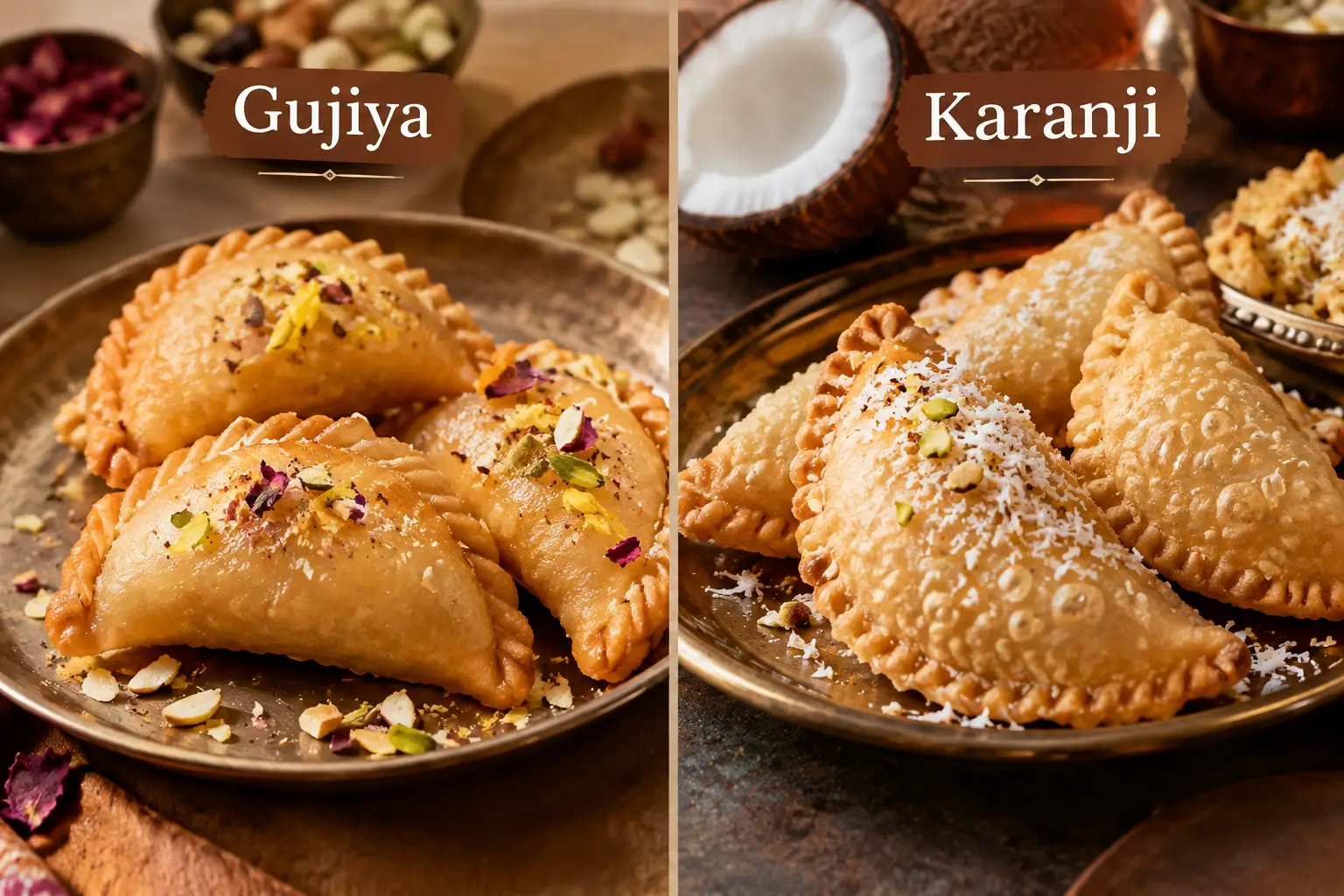
Think of them as regional cousins!
Both follow a similar basic method:
Prepare a dough.
Roll it into thin rounds.
Add a sweet filling.
Fold it into a half-moon.
Seal and decorate the edges.
Fry until crisp.
What changes is the culinary tradition around them.
A typical North Indian gujiya is often associated with milk solid (khoya-based) fillings, while Maharashtrian karanji is strongly associated with coconut-based fillings. But even this is not an absolute distinction. Gujiya can contain coconut, and karanji can contain khoya or other ingredients.
So if someone calls a karanji a type of gujiya, they are pointing to their similarities. If someone says they are different, they are referring to their regional recipes and traditions.
Both perspectives make sense depending on how broadly you define the category.
Gujiya vs Karanji: What’s the Difference in Ingredients?
The filling is one of the easiest ways to tell gujiya and karanji apart. While both are sweet, filled pastries, their traditional fillings tend to use different ingredients and have noticeably different textures.
Traditional Gujiya Filling
A classic North Indian gujiya commonly contains:
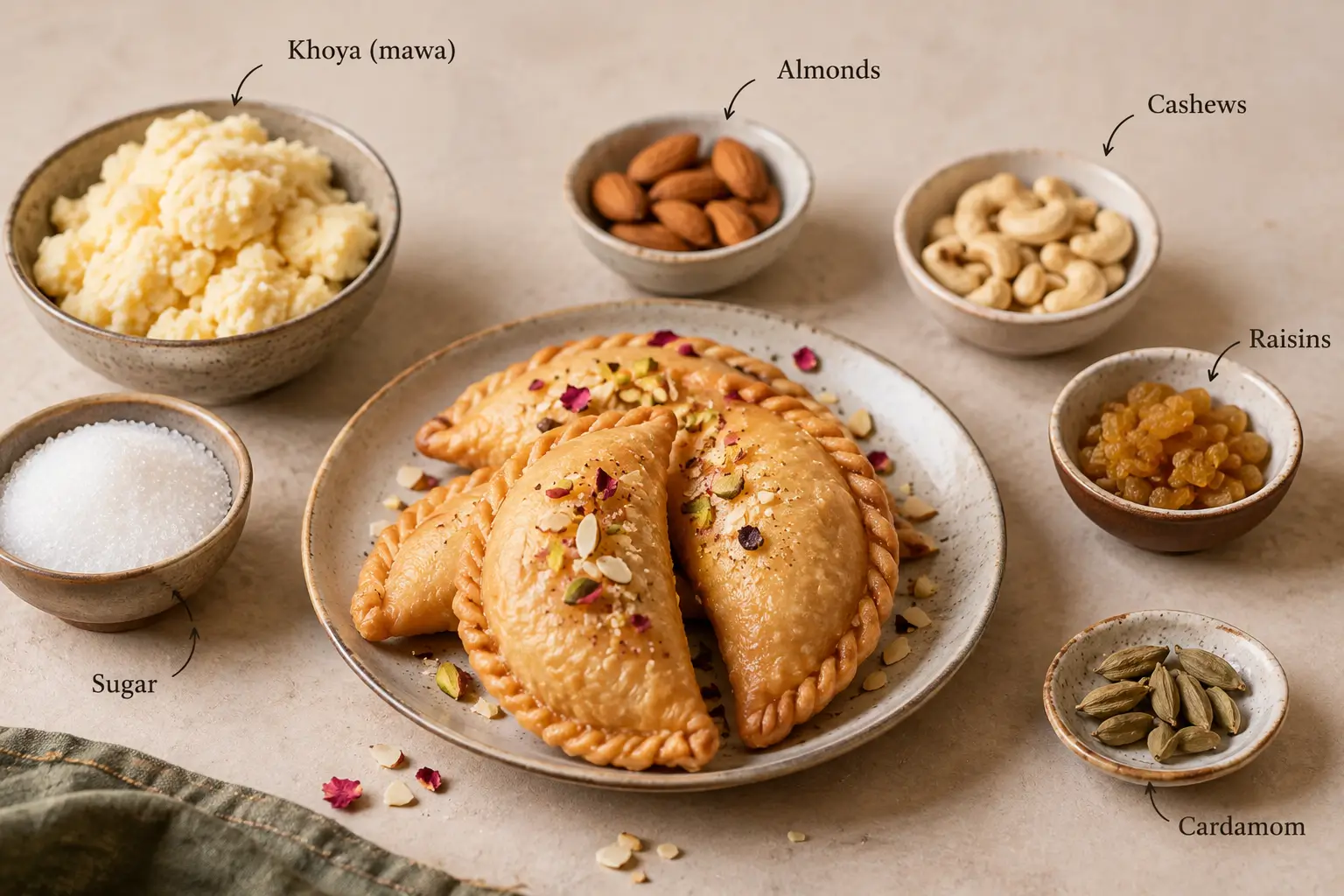
Khoya or mawa (reduced milk solids)
Sugar
Cardamom
Almonds
Cashews
Raisins
Other dried fruits or nuts
Khoya gives the filling a rich, milky texture and is one of the defining ingredients in many traditional North Indian gujiyas.
Depending on the region and family recipe, gujiya may also contain coconut, semolina (coarsely ground wheat), or jaggery instead of, or alongside, the more traditional khoya-based filling.
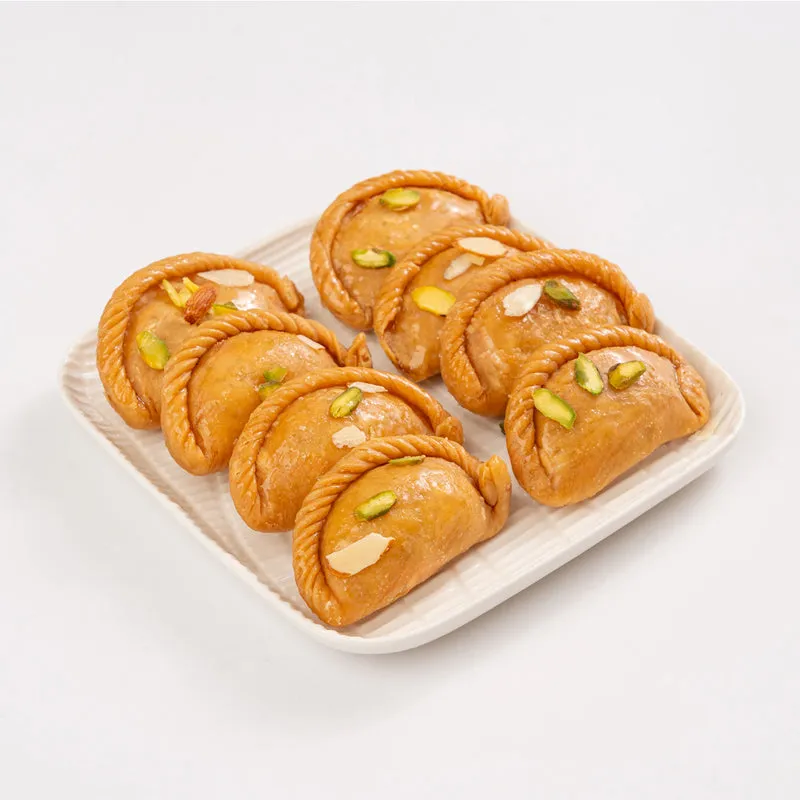
For a ready-made example of this traditional style, Dadu's Khova Gujia uses a rich khoya filling with sugar, cardamom, almonds, and pistachios inside a crisp ghee-fried shell.
Traditional Karanji Filling
A Maharashtrian karanji more commonly has a coconut-based filling made with:
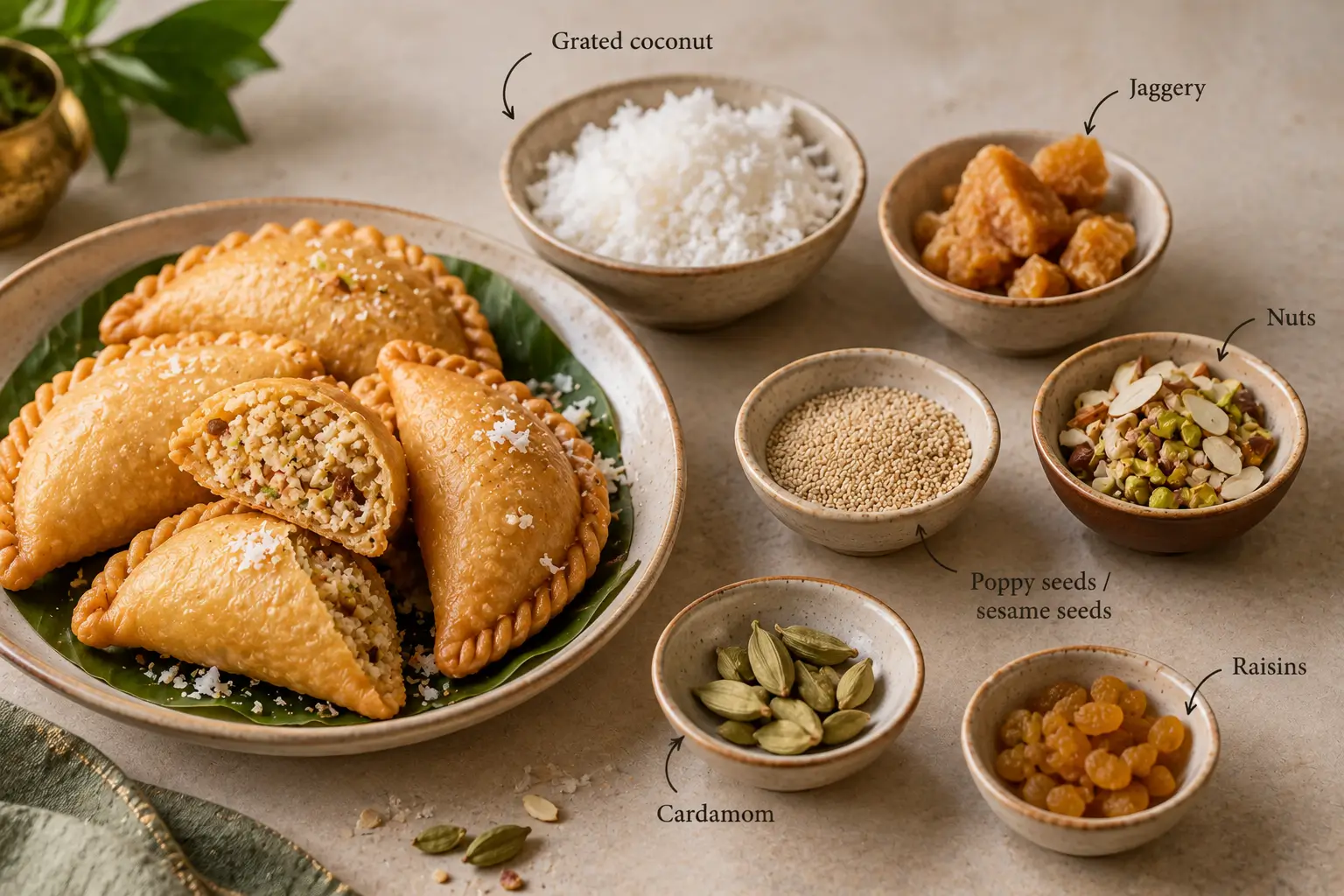
Grated or dried coconut
Sugar or jaggery (unrefined cane sugar)
Cardamom
Poppy seeds or sesame seeds
Nuts
Raisins
This gives karanji a more coconut-forward flavor and a slightly grainier, nuttier texture compared with a khoya-heavy gujiya.
Maharashtra Tourism also describes traditional karanji fillings using ingredients such as coconut, jaggery or sugar, nuts, dry fruits, and aromatic spices.
If you'd like to see how these traditional fillings translate into ready-made sweets, here are a few karanji options available from The Desi Food.

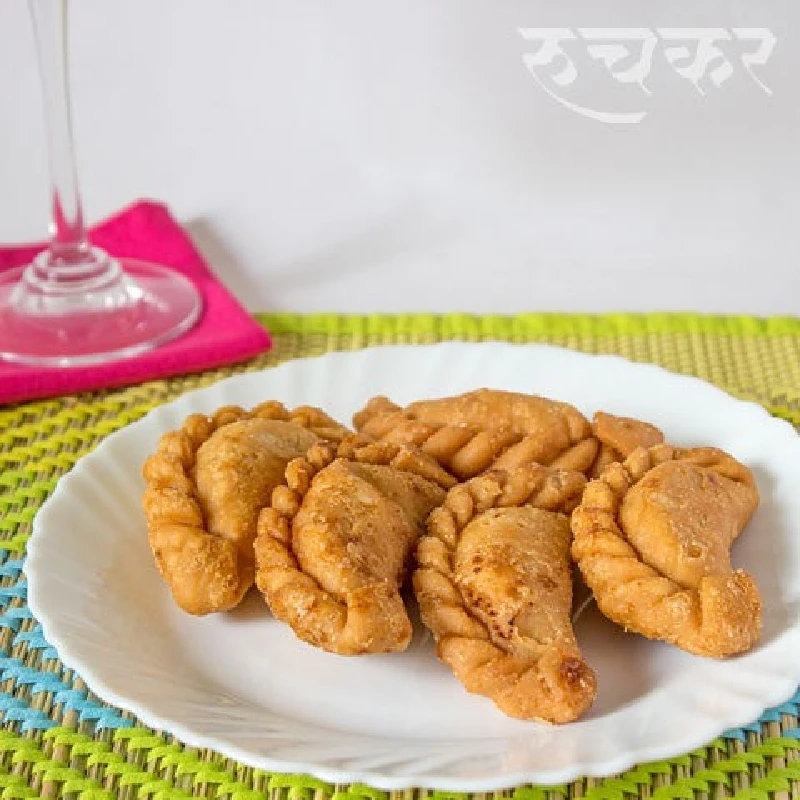
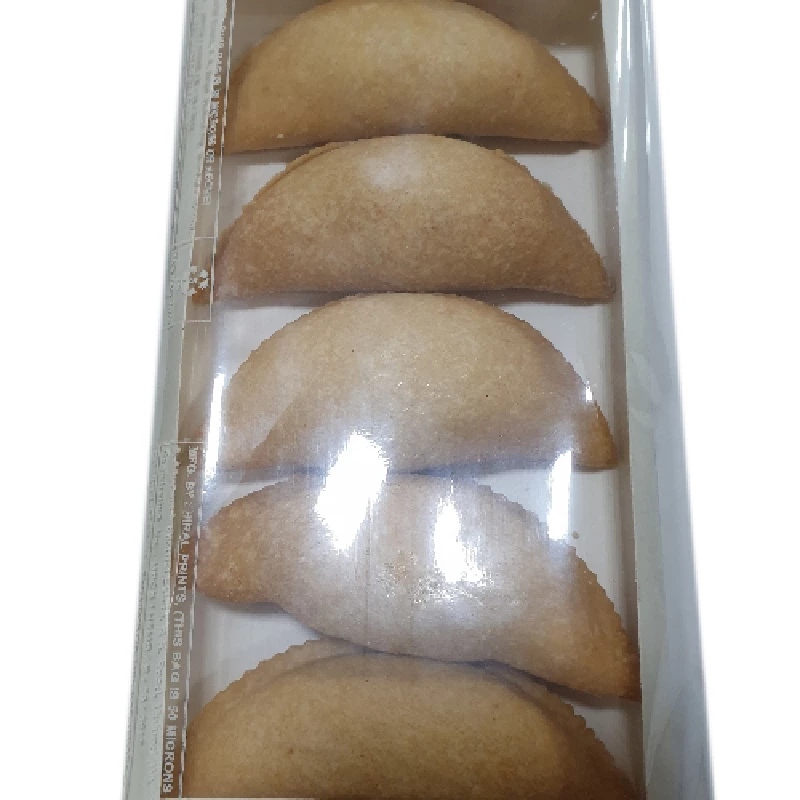
Gujiya vs Karanji: At a Glance
Gujiya | Karanji | |
Common filling | Khoya, sugar, nuts, dried fruits | Coconut, sugar or jaggery, nuts, seeds |
Main flavor | Rich and milky | Coconut-forward and nutty |
Texture | Soft, rich filling | More textured and slightly grainy |
Regional association | North India | Maharashtra |
Major festival | Holi | Diwali |
Why Do Gujiya and Karanji Look So Similar?
Because the underlying preparation is remarkably similar.
Both are essentially filled fried pastries. A thin sheet of dough is wrapped around a sweet filling and sealed at the edges.
That basic format is not unique to one part of India. Different regional food cultures have developed their own versions using locally available ingredients.
This is why you find similar crescent-shaped sweets across the country, even though the names and fillings change.
The shape may stay familiar while the filling tells you where the sweet belongs.
Gujiya and Karanji History: What Do We Actually Know?
The history of gujiya is harder to pin down than you might expect. There is no universally accepted historical record that identifies one place and one date as the definite birthplace of gujiya or its regional relatives.
Several theories have been suggested over the years. Some food-history accounts connect gujiya with older Indian preparations such as anse or erse, while another theory points to similarities between gujiya and filled pastries found across the Middle East and Central Asia, including qottab, a pastry traditionally associated with Iran. There are also accounts linking the development of gujiya with the Braj region (the area around Mathura and Vrindavan in northern India), where it became closely associated with local food traditions and festivals.
What makes the history tricky is that these theories don't all have the same level of historical evidence. There isn't enough documentation to confidently say that gujiya came from one particular country or was invented at a specific point in history.
A more accurate way to understand its history is that gujiya belongs to a much broader tradition of filled pastries and sweets, with its own Indian forms developing across different regions over time. The exact origin of the preparation remains debated.
Karanji and Gujiya History in Maharashtra
Karanji has a strong place in Maharashtrian festive cooking.
It is traditionally associated with Diwali faral, an assortment of homemade sweets and savouries that are prepared and shared during the festival. Maharashtra Tourism specifically lists karanji among the traditional foods prepared for Diwali.
It is also prepared during Ganesh Chaturthi. Incredible India describes karanji as a Maharashtrian delicacy offered during the festival and notes its resemblance to gujiya from North India.
The ingredient choices make sense within the broader food traditions of the region. Coconut, nuts, seeds, and jaggery are prominent in many Maharashtrian preparations, and these ingredients naturally found their way into festive sweets.
What Does Gujiya Mean?
The Hindi word "gujiya," written as गुजिया, refers to a sweet-shaped festival pastry somewhat like a samosa or crescent-shaped pastry.
The Rekhta Dictionary defines gujiyaa as a type of sweet-shaped festival that is also a samosa and also records another meaning referring to a small earring.
However, the precise etymological origin of the food name is not firmly established in the historical sources available.
That is worth mentioning because food names often acquire different explanations over time, and an appealing explanation is not necessarily a documented one.
Gujiya vs Karanji: What About the Festivals?
The festival association is one of the easiest ways to distinguish the two in popular Indian food culture.
Gujiya and Holi
Gujiya is strongly associated with Holi, especially in North India.
During Holi, families prepare or buy gujiyas to share with relatives and guests. The sweet has become so closely linked with the festival that it is often treated as one of its signature foods.
Karanji and Diwali
Karanji has a particularly strong association with Diwali in Maharashtra.
It forms part of the traditional Diwali faral alongside foods such as chakli, shankarpali, and ladoos. Maharashtra Tourism lists karanji among the state's traditional Diwali delicacies.
Karanji is also prepared for other celebrations, including Ganesh Chaturthi.
This difference in festival identity is just as important as the ingredients.
What About Ghughra, Pedakiya and Nevri?
Gujiya and karanji are not the only Indian sweets built around the idea of a filled, folded pastry. Different regions have their own versions, with variations in the filling, shape, dough and occasions when they are prepared.
Ghughra
In Gujarat, a similar sweet is commonly called ghughra. It is a traditional Gujarati pastry with a sweet filling and is closely related to gujiya and karanji. Gujarat Tourism also lists gujia, gujhia, and karanji among the names associated with this style of sweet.
Pedakiya
In Bihar, you'll find pedakiya, a traditional filled sweet particularly associated with festivals and special occasions. It can have fillings that differ from the khoya-based mixture commonly found in North Indian gujiya.
Nevri
Goa has nevri, a similar folded pastry that is prepared for several celebrations, including Christmas and Ganesh Chaturthi. Depending on the recipe, the filling may include coconut, jaggery (unrefined cane sugar), sesame seeds, or other sweet ingredients.
Kajjikayi and Somas
Southern India has its versions too. Kajjikayi, also spelled kajjikayalu in some regions, is found in parts of Karnataka and Andhra Pradesh, while somas is a similar fried, filled pastry from Tamil Nadu.
The names and recipes may change from one region to another, but the basic idea remains familiar. A thin pastry is filled with something sweet, folded or sealed, and cooked until crisp. Looking at these regional versions makes the gujiya-versus-karanji comparison more interesting because there isn't just one recipe for this type of Indian sweet. There are many regional interpretations shaped by local ingredients, festivals, and food traditions.
Gujiya vs Karanji: Which One Has Khoya?
Khoya or mawa is strongly associated with many North Indian gujiyas.
Karanji is more commonly associated with coconut-based fillings in Maharashtra, although some Maharashtrian versions also use khoya and other rich ingredients.
So if you bite into a sweet crescent filled with soft, milky khoya, you are more likely to be eating a North Indian-style gujiya.
If the filling is predominantly coconut, sugar, jaggery, nuts, or seeds, it may be a Maharashtrian-style karanji.
But recipes vary, so the filling alone cannot always identify the sweet with certainty.
Gujiya and Karanji: More Alike Than Different
At the end of the comparison, the easiest way to understand these two sweets is to look at both their similarities and differences.
They are similar because:
Both use a thin pastry-like outer layer.
Both have sweet fillings.
Both are generally crescent-shaped.
Both are traditionally fried.
Both are associated with festivals.
Both have regional and family variations.
They differ because:
Gujiya is strongly associated with North India and Holi.
Karanji is strongly associated with Maharashtra and Diwali.
Gujiya commonly uses khoya or mawa in its North Indian form.
Karanji commonly uses coconut-based fillings.
Their regional histories and culinary traditions are different.
Both have evolved into many variations rather than following one fixed recipe.
One Sweet, Many Regional Identities
Gujiya and karanji are a good example of how Indian food traditions rarely fit neatly into one origin story or one recipe.
The two sweets share a familiar format: a crisp outer shell wrapped around a sweet filling. But as that format travelled across regions and became part of local festive traditions, different communities made it their own.
In North India, that gave gujiya its strong connection with Holi and khoya-based fillings. In Maharashtra, karanji became part of Diwali faral, with coconut, jaggery, nuts, and aromatic spices taking center stage. These regional differences are what give each sweet its own identity, even when the basic idea behind them remains much the same.
Frequently Asked Questions
You May Also Like
View all Articles Delicacies
Deliciously Desi: 10 Easy Gujarati Breakfast Recipes and Snacks to Elevate Your Morning!
By ChaitanyaAug 11, 2026 Delicacies
Best Indian Pickle: Spice Up Your Meals, Anywhere in the World
By Saroja HuddarAug 11, 2026 Delicacies
15 Best Indian Snacks Loved Worldwide (Healthy & Indulgent)
By Saroja HuddarAug 11, 2026