Benefits of Mustard Oil: Is It Good for Health?
Mustard oil adds bold flavor to Indian cooking, but its health benefits and US cooking rules deserve closer attention. Here's what to know before using it.
Latest Articles
 Wellness
What Is Avipattikar Churna? Ingredients, Traditional Uses and Safety
Oct 8, 2026
 Staples
Organic Honey vs Regular Honey: What the Label Covers and What It Doesn't
Oct 8, 2026
 Beauty
8 Best Natural Shampoos for Men to Buy Online in the USA, UK and Beyond
Oct 8, 2026
 Wellness
Best Ayurvedic Herbs for Sleep: 8 Herbs and the Forms They Come In
Sep 30, 2026
Mustard oil has a personality that most cooking oils simply don't have. Pour it into a hot pan, and you get that unmistakable sharp, peppery aroma. Let it mellow as it heats, and it becomes much more rounded, carrying a deep flavor that works beautifully with fish, vegetables, dals, pickles, and many North and East Indian dishes.
In India and across South Asia, mustard oil, often called sarson oil or sarson ka tel, has been a kitchen staple for generations. But if you're shopping for it in the US, you may have noticed something confusing. Some bottles are labeled for external use only.
So, is mustard oil good for health? What are the actual benefits of mustard oil? And can you cook with it in the US?
The answer needs a little more nuance than a simple yes or no.
Quick Answer: What Are The Benefits Of Mustard Oil?
Mustard oil is valued primarily for its distinctive flavor, its predominantly unsaturated fat profile, and the role it plays in traditional South Asian cooking. It contains monounsaturated and polyunsaturated fats and naturally occurring compounds from mustard seeds.
But it is important not to treat mustard oil as a medicine. Claims that it prevents disease, boosts immunity, improves digestion, or treats inflammation go beyond what current human evidence can establish.
There is also an important US-specific consideration.
Expressed mustard oil can contain significant amounts of erucic acid, and the FDA currently has an import alert on it due to concerns about unsafe levels of erucic acid. Always check the product's label and make sure it is legally intended for the use you have in mind.
What Is Mustard Oil?
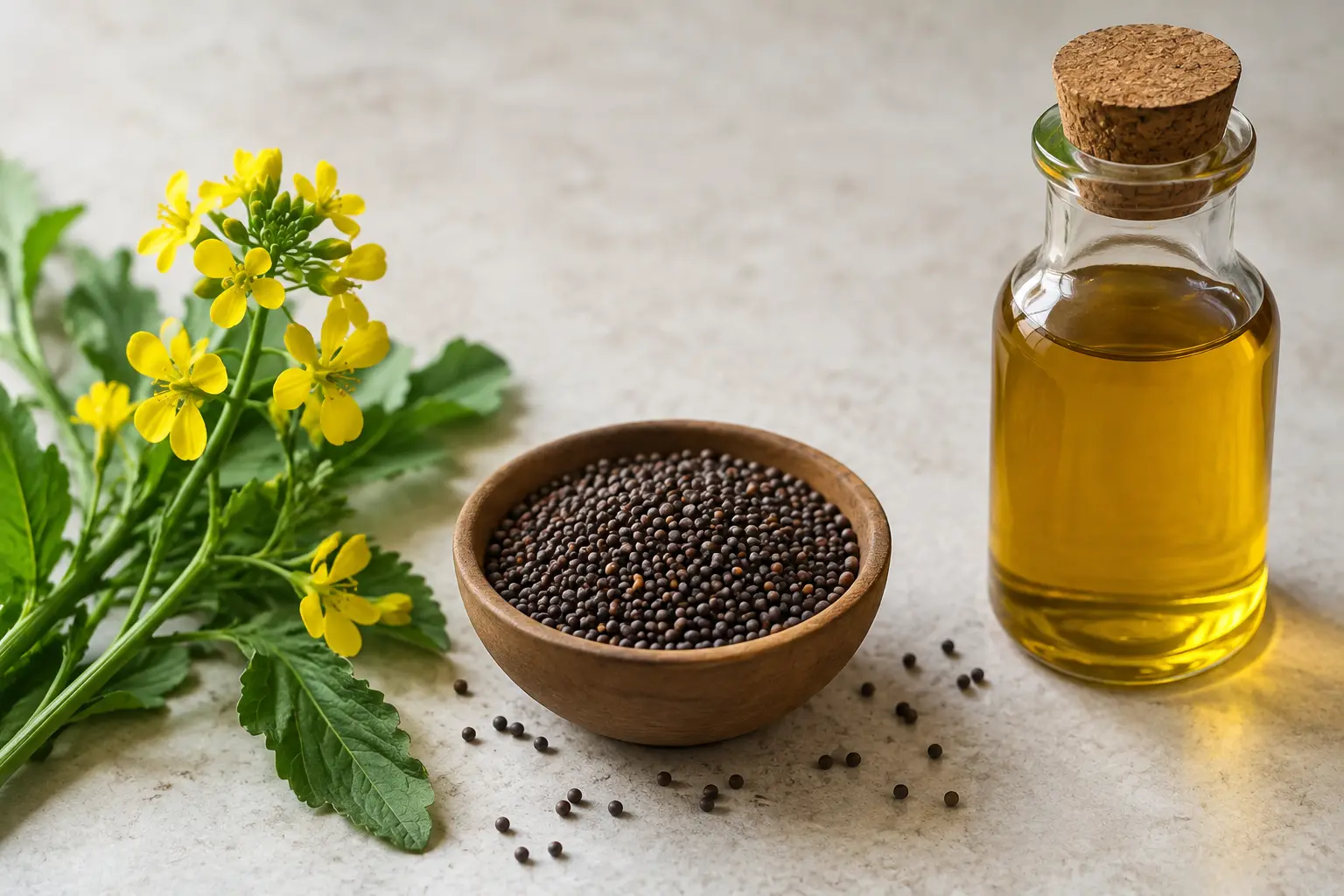
Mustard oil is made by pressing mustard seeds from plants in the Brassica family.
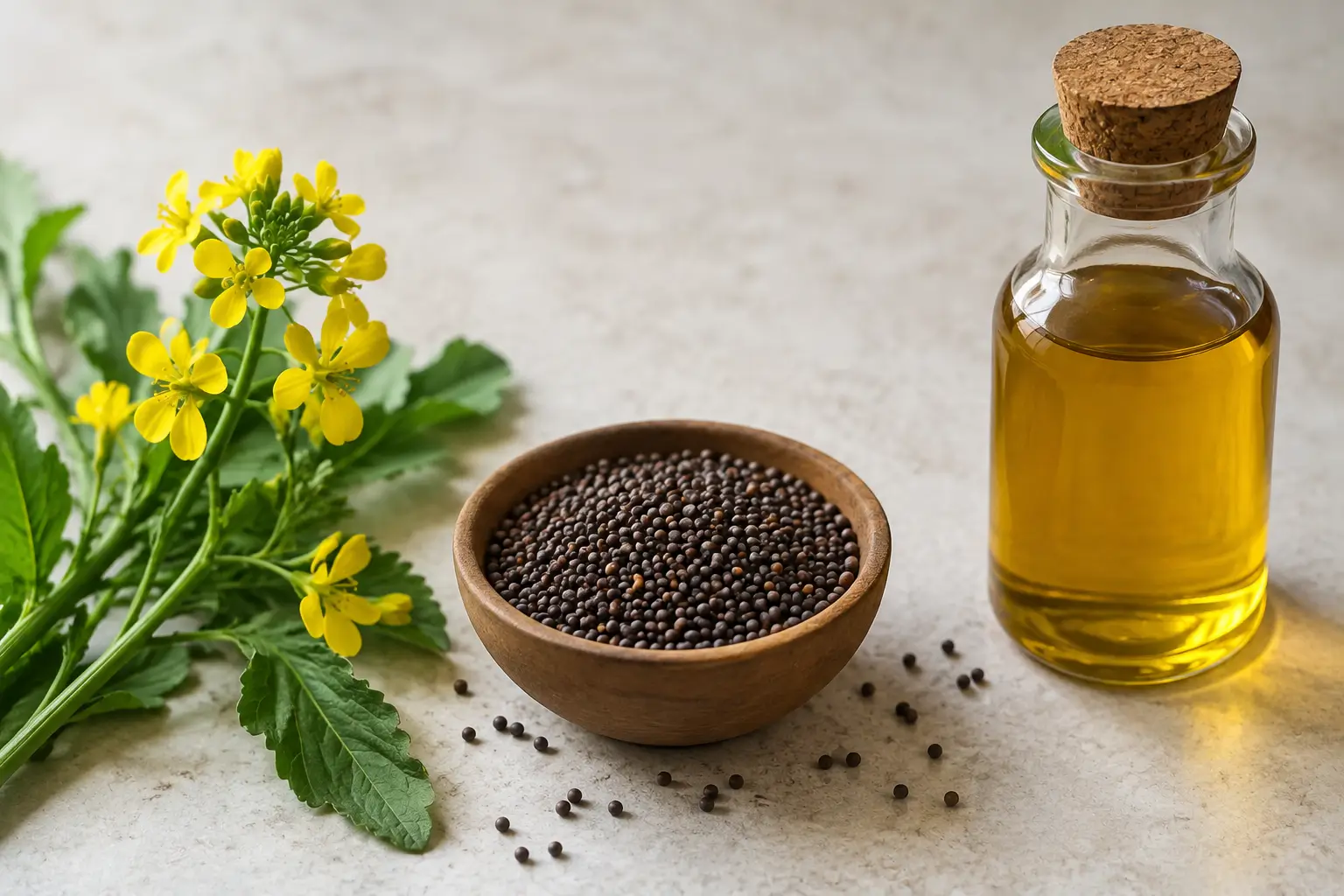
Depending on the seeds used and how the oil is processed, it can range from golden yellow to deeper amber and can have a surprisingly strong aroma.
In India, you'll often hear it being called sarson oil, sarson ka tel, or kachi ghani mustard oil.
That last term refers to a traditional cold-pressing method. Cold-pressed mustard oil tends to retain more of the seed's characteristic aroma and flavor, which is exactly what many people are looking for when they buy it.
And yes, the smell can be intense when you first open the bottle.
That's not necessarily a sign that something is wrong with it. The pungency is part of what makes mustard oil so distinctive.
Why Does Mustard Oil Taste So Strong?
If you're new to mustard oil, the first taste can be a surprise.
It has a sharp, almost nose-tingling quality that you won't get from canola, sunflower, or most refined vegetable oils. Mustard seeds contain compounds that contribute to this pungency, which is also found in horseradish and wasabi.
This is one reason mustard oil isn't really a neutral cooking oil.
You don't use it simply because you need something to coat a pan. You use it because you want the flavor it brings to the dish.
That's particularly true in dishes such as Bengali-style fish preparations, sarson-based recipes, pickles, dals, and vegetable dishes where the oil is part of the flavor profile rather than an invisible cooking medium.
Mustard Oil Benefits: What Does The Evidence Actually Tell Us?
1. It contains mostly unsaturated fats
One of the main nutritional advantages of mustard oil is its fatty-acid profile. Traditional mustard oils are generally rich in monounsaturated and polyunsaturated fats and relatively lower in saturated fat.
That matters because replacing foods high in saturated fat with sources of unsaturated fat can be part of a heart-healthy eating pattern.
But there's an important distinction here. This does not mean mustard oil itself has been proven to prevent heart disease or lower cholesterol in everyone.
Think of it as one part of the overall diet, not a health treatment.
2. It contains naturally occurring antioxidant compounds
Mustard seeds contain naturally occurring compounds, including tocopherols such as vitamin E and other plant compounds. The amount varies depending on the mustard variety and how the oil is processed.
Cold-pressed oils generally retain more of the characteristics of the original seed than heavily refined oils, which is one reason people often prefer kachi ghani mustard oil for its flavor and aroma.
Still, “cold-pressed” shouldn't automatically be read as “proven healthier in every respect.” Processing, composition, storage, and the overall diet all matter.
3. It brings a lot of flavor without needing much
This is a benefit that nutrition tables don't really capture.
Mustard oil has such a pronounced flavor that a relatively small amount can change the character of an entire dish.
A little can be enough for a vegetable stir-fry or dal. A larger amount can become part of the base of a curry or marinade. And in Indian pickles, mustard oil isn't just there for cooking, it is an important part of the final flavor.
For someone trying to make food taste more interesting without relying on heavy sauces, this can be a very practical advantage.
4. It has a long culinary tradition in South Asia
Mustard oil isn't a recent “superfood” trend.
It has deep roots in Indian and South Asian cooking, with particularly strong culinary associations in regions such as Bengal, Bihar, Odisha, Punjab, and parts of North India.
That history is useful context because many of the ways people use mustard oil today make sense once you understand the food traditions around it.
For example, mustard oil and fish are a classic pairing in Bengali cooking. It also pairs well with mustard seeds, green chilies, turmeric, garlic, and other ingredients that can balance its strong flavor.
Can You Cook With Mustard Oil?
Mustard oil is traditionally used as a cooking oil in South Asian cuisines. But the regulatory situation in the United States is different.
The FDA's current Import Alert 26-04 covers expressed mustard oil, including cold-pressed mustard oil, because some expressed mustard oils can contain 20-40% erucic acid. The FDA states that mustard oil containing unsafe levels of erucic acid is considered an unsafe food additive under US law.
So if you're in the US, don't assume that a bottle labeled “mustard oil” is automatically approved for use as an everyday cooking oil.
Check the product label and its intended use, and follow current US regulations. A bottle marked “for external use only” should not be used for cooking.
This is also why it's important to distinguish expressed mustard oil from the very small amounts of volatile mustard oil/essential mustard oil used as a flavoring. The FDA treats these as different products.
If you're outside the US, the rules can be different, so follow the food-safety requirements that apply where you live.
Why Do Indian Recipes Heat Mustard Oil First?
If you've watched someone cook with mustard oil, you've probably seen them heat it before adding the other ingredients.
There's a reason for that.
Fresh mustard oil has a very pronounced raw pungency. Heating changes its aroma and flavor, making it less aggressively sharp and more integrated into the dish.
But that doesn't mean you need to deliberately heat the oil until it is smoking.
If a recipe tells you to heat mustard oil first, follow the recipe's intended cooking method rather than treating “smoke point” as a target you always need to reach.
And if you're cooking in the US, the regulatory question comes before the cooking technique. Make sure the particular product is legally intended for culinary use.
What Is Kachi Ghani Mustard Oil?
Kachi Ghani generally refers to mustard oil extracted using a traditional cold-pressing method.
You'll see the term frequently on Indian mustard oil bottles because people associate it with a more traditional style of extraction and with the strong, characteristic flavor of mustard seeds.
If you're buying mustard oil for its traditional culinary character, look at the processing method, ingredient list, intended use, and labeling, rather than assuming that “Kachi Ghani” alone tells you everything about the product.
Cold-pressed also doesn't mean that every nutritional or health claim made about the oil is automatically true.
How To Choose Mustard Oil
If you're shopping for mustard oil, pay attention to four things:
1. Intended use: Make sure the label clearly indicates what the product is intended for.
2. Ingredients: Look for a straightforward ingredient list and check whether anything has been added.
3. Processing: If you specifically want traditional mustard oil, look for terms such as Kachi Ghani" or "cold-pressed."
4. Flavor: Darker, strongly aromatic mustard oils can have a much more pronounced flavor than milder varieties. If you're new to mustard oil, start with dishes where that flavor is meant to be noticeable.
Looking For Kachi Ghani Mustard Oil?
If you're specifically looking for a cold-pressed mustard oil with the characteristic pungent flavor associated with traditional Indian cooking, ORGANIC INDIA Kachi Ghani Mustard Oil is one option available through DesiFood.
It's made from the first press of organic mustard seeds and is described by the manufacturer as a cold-pressed Kachi Ghani oil with a strong mustard aroma.
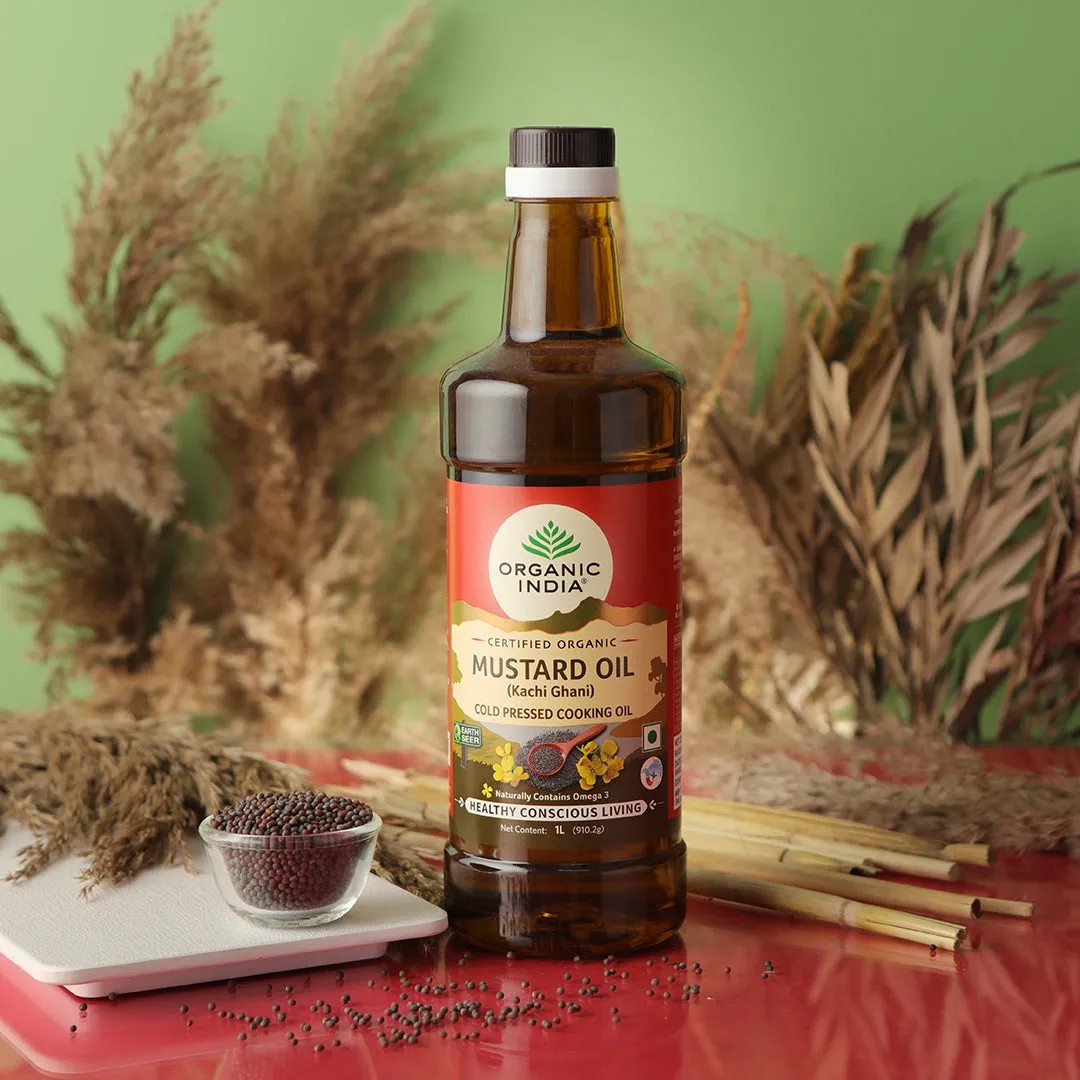
US shoppers should check the product label and current applicable regulations before using any mustard oil for cooking.
Mustard Oil vs Other Cooking Oils
There isn't one cooking oil that is automatically “the healthiest” for every person or every dish.
Cooking oil | Flavor | Works particularly well for |
Mustard oil | Strong, pungent | Indian curries, fish, pickles, dals |
Canola oil | Mild, neutral | Everyday cooking and baking |
Olive oil | Fruity or peppery | Dressings, sautéing, Mediterranean dishes |
Ghee | Rich and buttery | Tadka, roasting, finishing |
The right choice often comes down to both nutrition and what you want the food to taste like.
That's especially true with mustard oil. If you're making a Bengali fish curry, for example, replacing mustard oil with a completely neutral oil may change the character of the dish even if the recipe technically still works.
Mustard Oil For Skin And Hair: Does That Count As A Health Benefit?
You'll also see mustard oil discussed for massage, hair care, and skin.
These are traditional uses, but they shouldn't be mixed together with the nutritional benefits of eating mustard oil.
Topical mustard oil can irritate some people's skin, and concentrated mustard products are not interchangeable with food-grade cooking oil. If you're using mustard oil on your skin or hair, check the product's intended use and stop if it causes irritation.
For that reason, it's better to treat mustard oil for skin and hair separately than to assume that consuming the oil produces the same effects.
So, Are The Benefits Of Mustard Oil Worth It?
Mustard oil is much more than another cooking oil.
For people familiar with Indian food, its flavor can be tied to a particular kind of cooking. For most it is the aroma of a Bengali fish curry, for others it is the sharpness of a homemade pickle, or maybe the depth it brings to a simple dal.
Nutritionally, it provides predominantly unsaturated fats and naturally occurring compounds from mustard seeds. But it is not a miracle oil, and many of the stronger health claims you'll find online go beyond the available evidence.
And if you're in the US, there's one extra step that matters. Check the label and regulatory status before using expressed mustard oil for cooking.
The best way to think about mustard oil is not as a cure-all but as a distinctive traditional ingredient that can be very useful when you understand what it is, how it tastes, how it behaves in food, and where it can legally be used.