
What Is Onam? Meaning, Story and Kerala's Harvest Festival
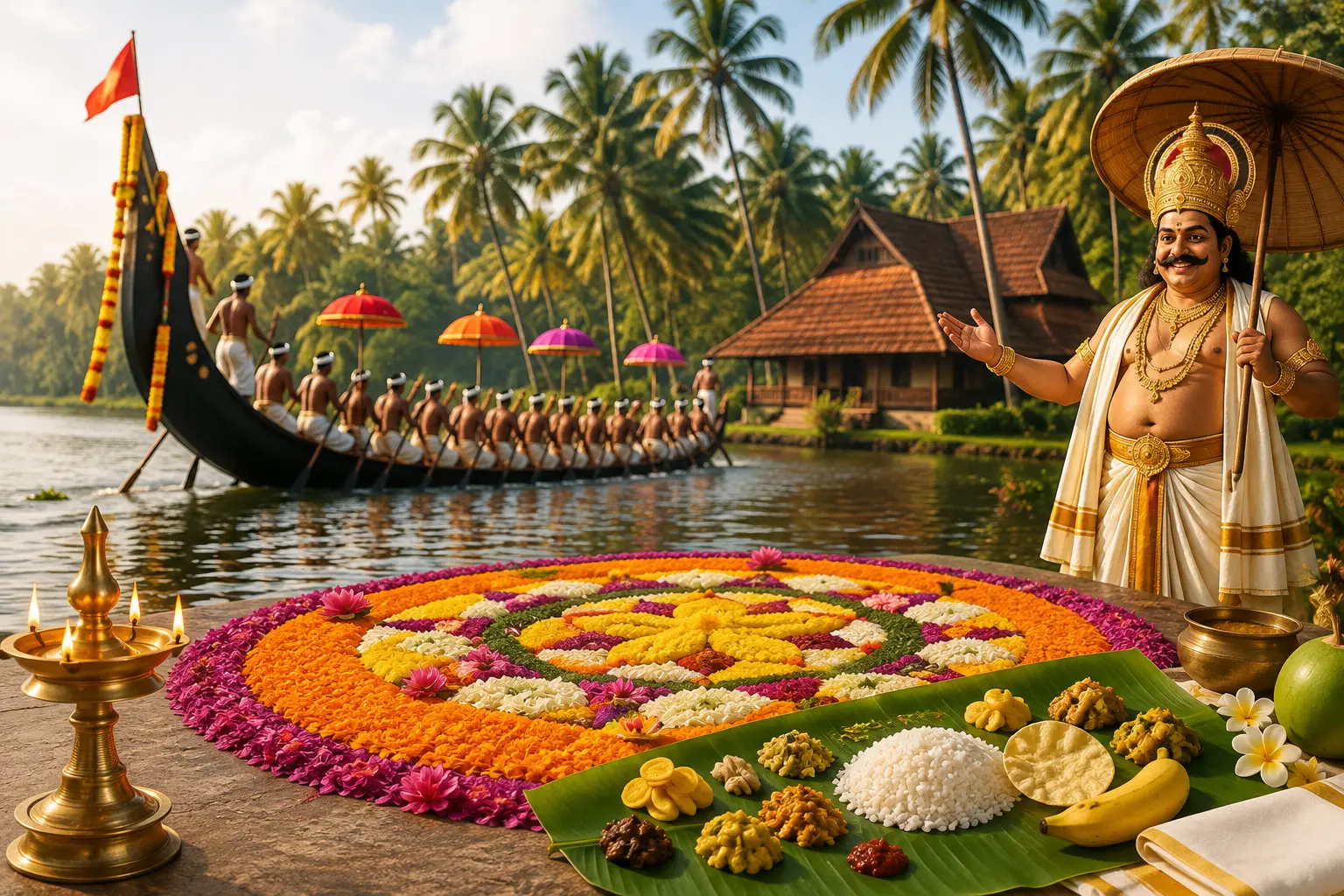
What Is Onam? Meaning, Story and Kerala's Harvest Festival
A colleague invites you to an Onam lunch. A neighbour lays out a circle of flower petals at their front door. Your child comes home from school talking about a king who visits once a year. You see the word on a friend's post and would rather look it up than ask.
Onam is the biggest festival of Kerala, a state on the south west coast of India. This guide covers what it is, the story behind it, when it falls in 2026, and what actually happens on the day.
If you already know Onam and you are marking it far from home this year, there is a section further down on how it works abroad, including why community celebrations in different cities fall weeks apart.
What is Onam Festival?
Onam (said OH-nam) is a harvest festival. It marks the day a much loved king named Mahabali is believed to come home once a year to see his people. People from Kerala are called Malayalis, after Malayalam, the language spoken there.
It runs for ten days. The last and most important day is called Thiruvonam. Homes get a carpet of fresh flowers at the front door, families wear new clothes, and everyone sits down to a large vegetarian meal served on a banana leaf.
Onam 2026 falls on Wednesday, 26 August 2026. That is Thiruvonam, the main day.
Onam 2026 date and the ten days
The ten days each carry the name of a star, not a number. Here is how they line up in 2026.
Day | Name | Date (2026) |
|---|---|---|
1 | Atham | Mon, 17 August |
2 | Chithira | Tue, 18 August |
3 | Chodhi | Wed, 19 August |
4 | Vishakam | Thu, 20 August |
5 | Anizham | Fri, 21 August |
6 | Thriketa | Sat, 22 August |
7 | Moolam | Sun, 23 August |
8 | Pooradam | Mon, 24 August |
9 | Uthradam (First Onam) | Tue, 25 August |
10 | Thiruvonam | Wed, 26 August |
Kerala takes four public holidays around it, from 25 August to 28 August 2026. The two days after Thiruvonam are called Avittam and Chathayam, or Third Onam and Fourth Onam.
You may see some websites print 16 August as the first day instead of 17 August. Neither one is wrong. A star can sit across two days, and different calendars pick a different one. The last day, Thiruvonam, is the same in all of them.
Why the date changes every year
Most Hindu festivals move with the moon. Onam does not. It follows the Malayalam calendar, which goes by the sun, and it lands on the star called Thiruvonam in the month of Chingam. Chingam is also the first month of the Malayalam year, so Onam and the Malayalam New Year come in the same few days.
So Onam always falls in late August or early September. In 2025 it was 5 September. In 2026 it is 26 August.
Why Onam festival is celebrated: the story of Mahabali
Long ago, Kerala was ruled by an asura king named Mahabali, called Maveli in Malayalam. In most stories, asuras are the bad ones. Mahabali was not.
Under him, nobody stole and nobody went hungry. Nobody was cheated. Rich and poor were treated the same. His people loved him for it, and the old Onam song still remembers his years as the time when everyone lived as equals.
That was the problem. Mahabali grew so powerful and so popular that the devas, the gods of the heavens, became uneasy. They went to Vishnu for help.
Vishnu came down as Vamana, a small brahmin boy, and walked into the king's court during a big ceremony. He asked for one small thing: three steps of land, measured by his own feet. The king's advisor guessed what was coming and told him to say no. Mahabali had never refused anyone in his life. He said yes.
Vamana then began to grow. With one step he covered the whole earth. With the second he covered the sky. There was nowhere left for the third.
Mahabali bowed his head and offered it, so that his promise would be kept. Vamana placed his foot there and pressed the king down into Patala, the world below.
But Vishnu had seen something in him. He gave Mahabali one wish, and the king asked for the only thing he wanted: to return once every year and see that his people were still happy and still well fed.
Onam is that visit. Everything about the festival is a preparation for a guest. The flowers at the door are for him. The new clothes are so he sees his people doing well. The feast is so he sees nobody is going hungry.
What people actually take from the story
One common reading is that the three steps show pride being cut down to size. That is a real part of the tradition.
But look at who Malayalis are cheering for. It is not the winner. Ten days of flowers and food are laid out for the king who lost everything and still kept his word. People remember the story less as a defeat and more as a picture of what a good ruler looks like. What you give away is what you are remembered for.
That is also why Onam does not really feel like a temple festival. It feels like a homecoming.
Onam is a harvest festival too
Chingam comes right at the end of the monsoon. The rain stops, the rice is ready, and everything looks bright again after weeks of grey. The first harvest is in, and there is food to share.
So Onam does two jobs at once. It is the story of a king coming home, and it is a simple thank you for a good year. The plenty in the story and the plenty in the fields are the same thing.
Who celebrates Onam
Nearly everyone in Kerala. Hindu, Christian and Muslim families all keep Onam, each in their own way. Schools hold pookalam contests and tug of war. Offices hold sadya lunches. The state made Onam the official festival of Kerala in 1961. Most people treat it as a Kerala festival first and a religious one second.
That is useful to know if you are explaining Onam to a colleague or to your child's teacher. Anyone can join in.
What happens during Onam
Pookalam. A round carpet of flower petals laid at the front door. It starts small on Atham, one simple ring, and a new layer is added each day until Thiruvonam, when it fills the doorway. Children usually own this job.
Onathappan. A small cone shaped clay figure put in the middle of the pookalam from the eighth day. It stands for the king himself.
Onakkodi. New clothes, given to family members rather than bought for yourself. Kasavu, the off white cotton with a gold border, is what most people reach for.
Onasadya. The feast. A vegetarian spread served on a banana leaf, everything laid out in a fixed order, eaten with your hands, and finished with payasam. A large sadya can run past twenty dishes.
Vallam kali. The snake boat races. Long narrow boats carry a hundred rowers or more, all pulling to the beat of boat songs.
Pulikali. Men painted as tigers, dancing through the streets to drums. Loud, funny, and a favourite with children.
Thiruvathira kali. A circle dance performed by women in kasavu, moving around a lamp.
What is in an Onam sadya
The sadya is the heart of the day, and everything has its place. Rice in the middle. Pickles, small curries and the crisp things along the top edge of the leaf, always in the same spots, so your hand knows where to go without looking.
A typical spread includes parippu with ghee, sambar, rasam, avial, thoran, olan, kaalan, pachadi, kichadi, mango pickle, inji puli, banana chips, sharkara varatti, pappadam, and one or two payasams to close.
You do not need twenty six dishes for it to count. A home sadya of eight or ten items, served properly on a leaf, is a real sadya. Rice, parippu, sambar, avial, thoran, pickle, pappadam and a payasam will do it.
For the full spread, what each dish is, and where everything sits on the leaf, read our guide to the Onam sadhya
Onam away from Kerala
Here is the part most guides leave out, and it is what confuses people the most.
Thiruvonam 2026 is a Wednesday. Outside Kerala, almost nobody can take a Wednesday off. So the community events move to weekends, and Onam turns into a season rather than one date.
In the United States this year, Kerala associations have spread their Onam programmes over about six weeks. The Greater Atlanta Malayalee Association held its event in early August. The Detroit Malayalee Association held its sadya on 22 August. In the Bay Area, Maithry has its Onam sadya and cultural programme on 5 September, and the Kerala Association of Washington is serving its sadya on 12 September. None of them are wrong. Halls have to be booked, cooks have to be shared, and volunteers have to be free.
The result is that many families abroad end up with two Onams, and both feel right.
The community Onam is the big one. A school hall or a banquet hall, a few hundred people, a full sadya on banana leaves served in time slots, thiruvathira, chenda drums, a pulikali for the kids. Sadya tickets are usually sold online ahead of time and they go fast, so check your local association's page as soon as the date is out.
The home Onam is on Thiruvonam itself. Smaller, quieter, and usually a weeknight. Flowers on the floor before work. A video call to Kerala. A shorter meal, on a leaf if you can find one.
Celebrating Onam at home when you have very little time
Lay a small pookalam. Any flowers work. Supermarket carnations, marigolds, even petals your children pull off a bunch of roses. All that matters is something bright on the floor when you walk in.
Cook two dishes, not twenty. Avial and a payasam will carry the day. Order or buy the rest.
Use a leaf if you can find one. Frozen banana leaves are cheap at most South Asian grocers and keep well. Thaw one, wipe it, and the whole meal feels different.
Wear something with kasavu. Even a shawl over ordinary clothes.
Put the boat races on. Vallam kali is streamed live, and it is great to watch over breakfast.
Call home during the meal, not after. Kerala is nine and a half hours ahead of New York, so an early sadya at your end lands in the evening at theirs.
Explaining Onam to children born abroad
Keep it short and let the story do the work. Something like this works well:
"There was a king who was so good to his people that even the gods got worried. He lost his kingdom because he kept a promise. He was allowed to come back and visit once a year, and this is that day. We put out flowers so he knows where we live, and we make a big lunch so he can see we are doing fine."
Children understand a guest coming to visit. That is really all Onam is.
Getting the ingredients together
The hard part of Onam abroad is usually not the cooking. It is the shopping. Matta rice, good coconut oil, jaggery for the payasam, sharkara varatti, A1 banana chips fried in coconut oil, pickles that taste the way they did at home. Local stores carry some of it, some of the time, and often not in the week you need it.
Ordering early helps more than anything else. If things are coming from India, count back from your celebration date and allow ten days to two weeks. Onam season is busy, and everyone orders at the same time. If you are cooking for a community sadya as well as a home one, put it all in a single order.