Kaishore Guggulu: Ingredients, Uses, Benefits, and What to Know
Learn about Kaishore Guggulu, its ingredients, traditional uses, potential benefits, dosage, safety, and what research says about this Ayurvedic formulation.
Latest Articles
 Wellness
What Is Avipattikar Churna? Ingredients, Traditional Uses and Safety
Oct 8, 2026
 Staples
Organic Honey vs Regular Honey: What the Label Covers and What It Doesn't
Oct 8, 2026
 Beauty
8 Best Natural Shampoos for Men to Buy Online in the USA, UK and Beyond
Oct 8, 2026
 Wellness
Best Ayurvedic Herbs for Sleep: 8 Herbs and the Forms They Come In
Sep 30, 2026
Kaishore Guggulu is a traditional Ayurvedic formulation made from a combination of herbs, fruits, and purified guggulu. It is available in tablet form and is commonly discussed in Ayurveda in connection with joint health, inflammation, and certain skin and metabolic concerns.
The formulation is commonly discussed in connection with Vatarakta, an Ayurvedic condition often compared with gout, as well as joint complaints, inflammatory conditions, and certain skin disorders. It is also listed among the important formulations in the Ayurvedic Formulary of India.
So rather than beginning with a list of supposed benefits, it makes more sense to start with the formulation itself. What exactly goes into Kaishore Guggulu? Why are those ingredients combined? Where does the formulation fit into Ayurvedic practice? And what does modern research actually tell us?
What Is Kaishore Guggulu?
Kaishore Guggulu is a classical Ayurvedic polyherbal formulation made from guggulu, three fruits that together form Triphala, Guduchi, three pungent herbs, and Vidanga.
The Ministry of Ayush lists Kaishora Guggulu in the Ayurvedic Formulary of India, Part I.
The formulation contains:
Haritaki (Harad)
Bibhitaki (Baheda)
Amalaki (Amla)
Guduchi (Giloy)
Guggulu
Shunthi (dry ginger or Sonth)
Pippali (long pepper or Choti Pippal)
Maricha (black pepper or Marich)
Vidanga (Vayavidanga)
These ingredients are traditionally used together rather than as nine unrelated herbs.
That distinction matters because evidence about one ingredient cannot automatically be used to prove that the complete formulation has the same effect.
What Are the Benefits of Using Kaishore Guggulu?
Research on Kaishore Guggulu is still developing, so it does not give us a complete picture of how effective the formulation may be for every condition it is traditionally used for. At the same time, this is not a formulation without a clear place in Ayurvedic practice.
Kaishore Guggulu has traditionally been used for Vatarakta, particularly in Ayurvedic approaches to complaints involving pain, swelling, and inflammation of the joints. It is also used in the traditional management of certain musculoskeletal and skin conditions.
In Ayurveda, the formulation is generally considered in the context of the person's symptoms and the condition being addressed, rather than simply being taken as a general supplement for joint health. That distinction matters because "joint pain" can have many different causes, and the traditional use of a formulation is tied to particular conditions and patterns.
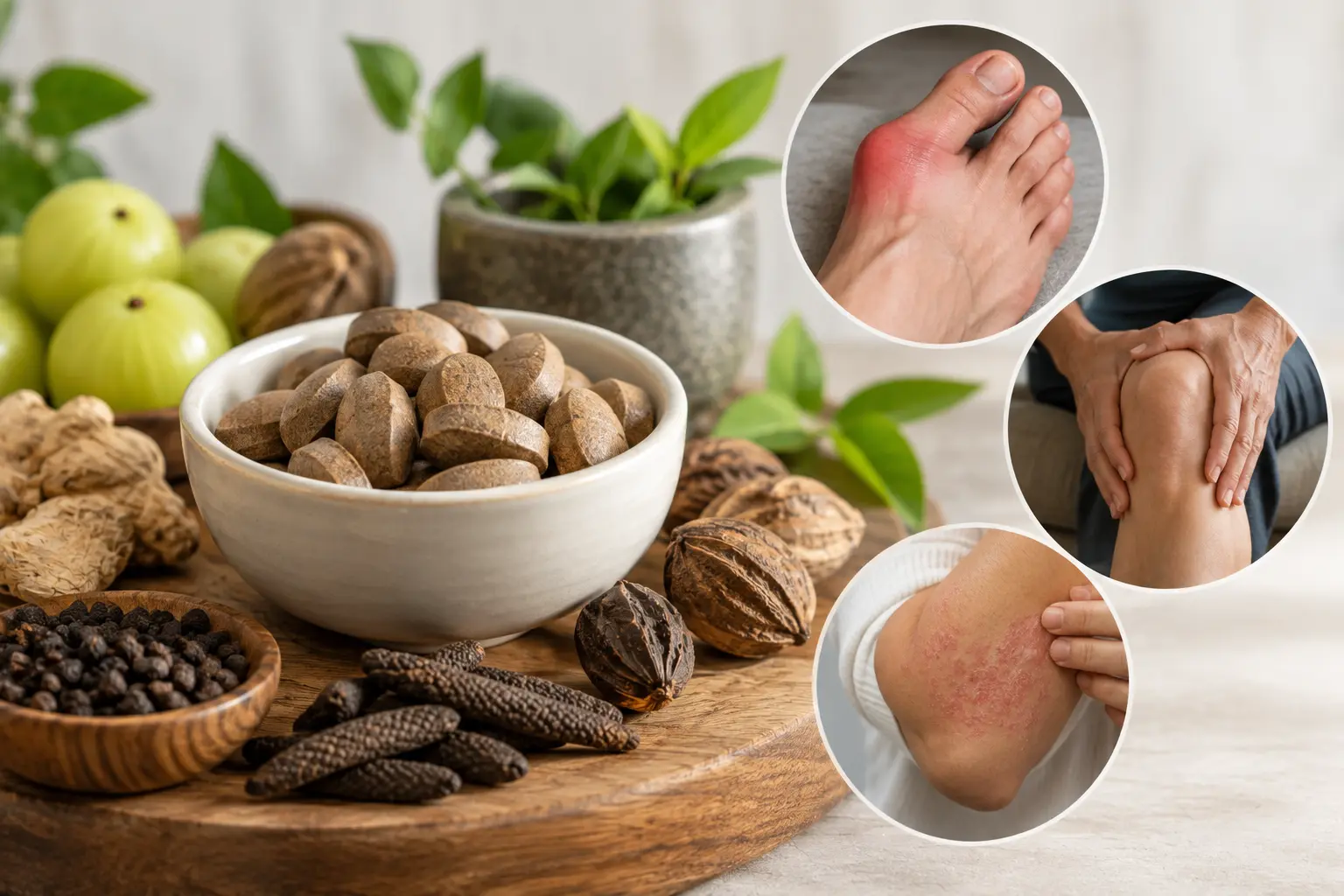
Here is where Kaishore Guggulu is most commonly discussed.
Gout and Vatarakta
Vatarakta is the condition most closely associated with Kaishore Guggulu. In Ayurvedic literature and practice, Vatarakta describes a condition involving the interaction of Vata and Rakta and is commonly compared with gout in modern discussions.
Kaishore Guggulu has been used traditionally as part of the Ayurvedic management of Vatarakta. The formulation is also being studied specifically in relation to gout.
The Central Council for Research in Ayurvedic Sciences (CCRAS) has conducted clinical research on Kaishore Guggulu in gout, including a study published in 2024. CCRAS also has an ongoing randomized controlled study examining Kaishore Guggulu along with Madhusnuhi Rasayana in primary gouty arthritis.
So, when Kaishore Guggulu is discussed in relation to gout, there is both a long-standing traditional use and a growing body of clinical research around that particular application. The available research is useful, although it is still not enough to establish the formulation's effects across all people with gout.
Joint and musculoskeletal complaints
Kaishore Guggulu is also used traditionally in Ayurvedic management of certain joint and musculoskeletal complaints, particularly where pain, stiffness, or inflammatory symptoms are part of the picture.
It is worth being specific here. Joint pain is a symptom, not a single condition. Gout, osteoarthritis, rheumatoid arthritis, an injury, and several other problems can all cause pain or swelling, but they require different approaches.
For that reason, Kaishore Guggulu's traditional association with joint health does not mean that it is used in the same way for every kind of joint problem. In Ayurvedic practice, the formulation is considered according to the particular condition and the symptoms being addressed.
Traditional skin-related use
Kaishore Guggulu also has a place in the traditional Ayurvedic management of certain skin conditions.
This use has been examined in clinical research as well. CCRAS records a study involving Khadirarishta, Kaishore Guggulu, and Gandhakadya Malahar in the management of Vicharchika, a condition commonly compared with eczema. The study was conducted across three centers and involved 120 participants.
This is useful context when looking at the traditional skin-related use of Kaishore Guggulu. The study examined a treatment approach that included Kaishore Guggulu alongside other Ayurvedic medicines, rather than testing it on its own. So the findings provide some research context for its use in this area while leaving room for further study of the formulation itself.
What about inflammation?
Several ingredients in Kaishore Guggulu have been investigated for biological effects associated with inflammation.
Guggulu, for example, has been studied extensively enough to have substantial scientific literature around its constituents and mechanisms. Yet even for guggulu itself, human evidence is limited for several of the conditions for which it is traditionally used.
That is why it is more accurate to say that Kaishore Guggulu has traditional anti-inflammatory applications and some supporting experimental research, rather than calling it a proven anti-inflammatory treatment.
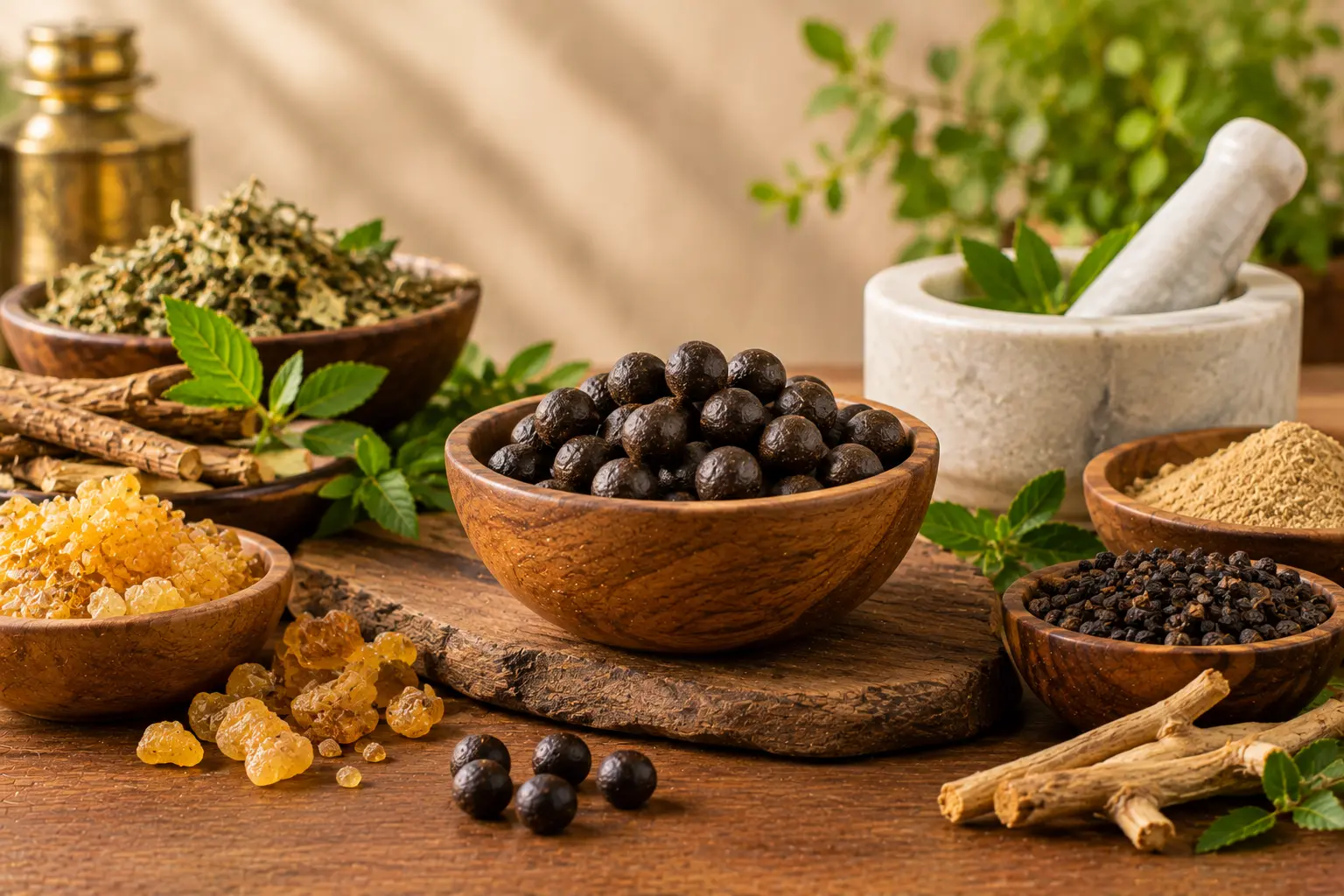
Kaishore Guggulu Ingredients
Kaishore Guggulu contains nine ingredients. Three of them, Haritaki, Bibhitaki, and Amalaki, are combined to form Triphala.
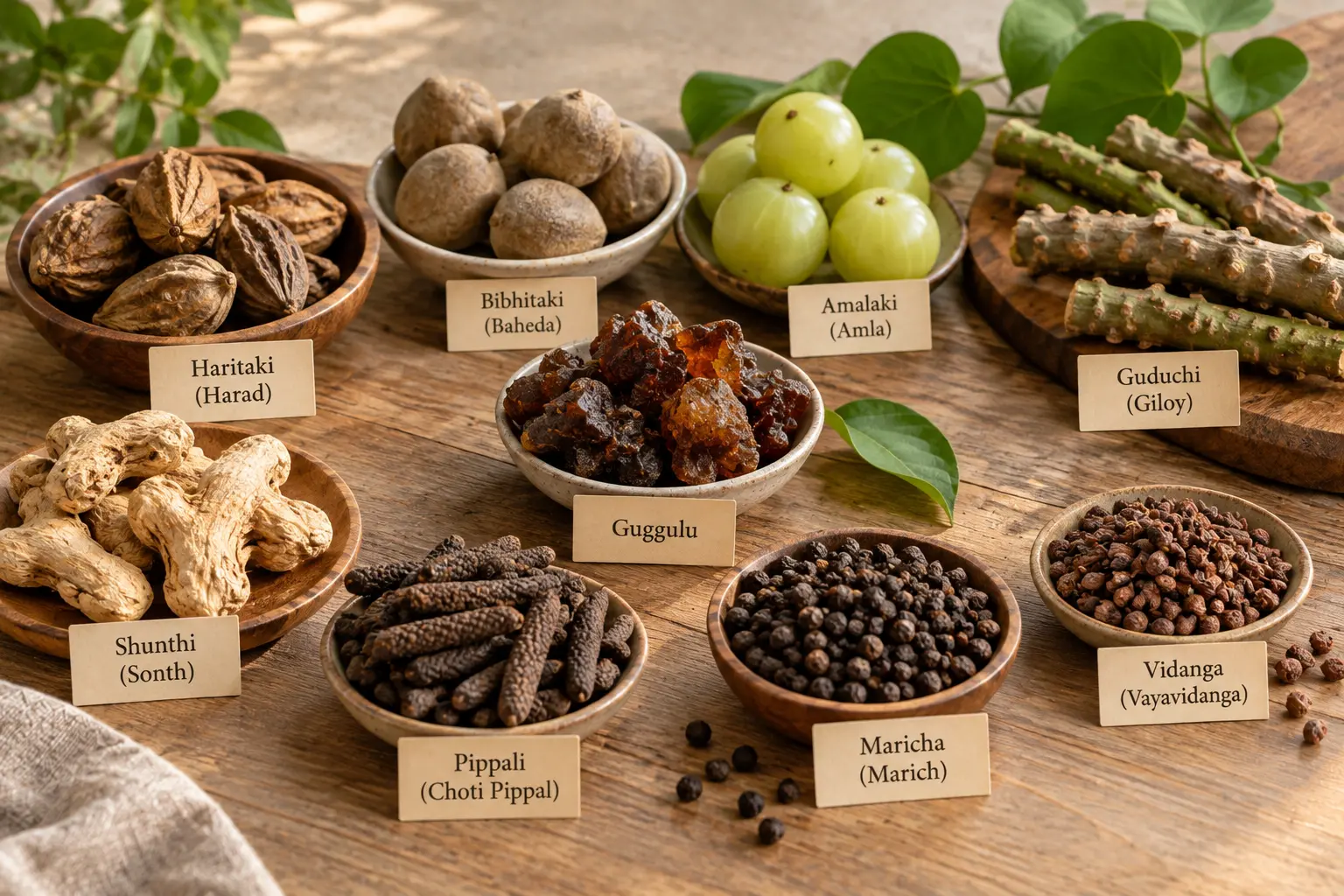
The complete ingredient list is:
Ingredient | Common name |
Haritaki | Harad |
Bibhitaki | Baheda |
Amalaki | Amla |
Guduchi | Giloy |
Guggulu | Guggul resin |
Shunthi | Dry ginger, Sonth |
Pippali | Long pepper, Choti Pippal |
Maricha | Black pepper, Marich |
Vidanga | Vayavidanga |
Haritaki
Haritaki, commonly called Harad, is the fruit of Terminalia chebula.
It is one of the three fruits that make up Triphala and is found in many traditional Ayurvedic formulations.
Bibhitaki
Bibhitaki, or Baheda, is the fruit of Terminalia bellirica. Together with Haritaki and Amalaki, it forms Triphala.
Amalaki
Amalaki, commonly known as Amla or Indian gooseberry, is the third component of Triphala. Its botanical name is Phyllanthus emblica. So when a product label says "Triphala," it refers to these three fruits in this formulation.
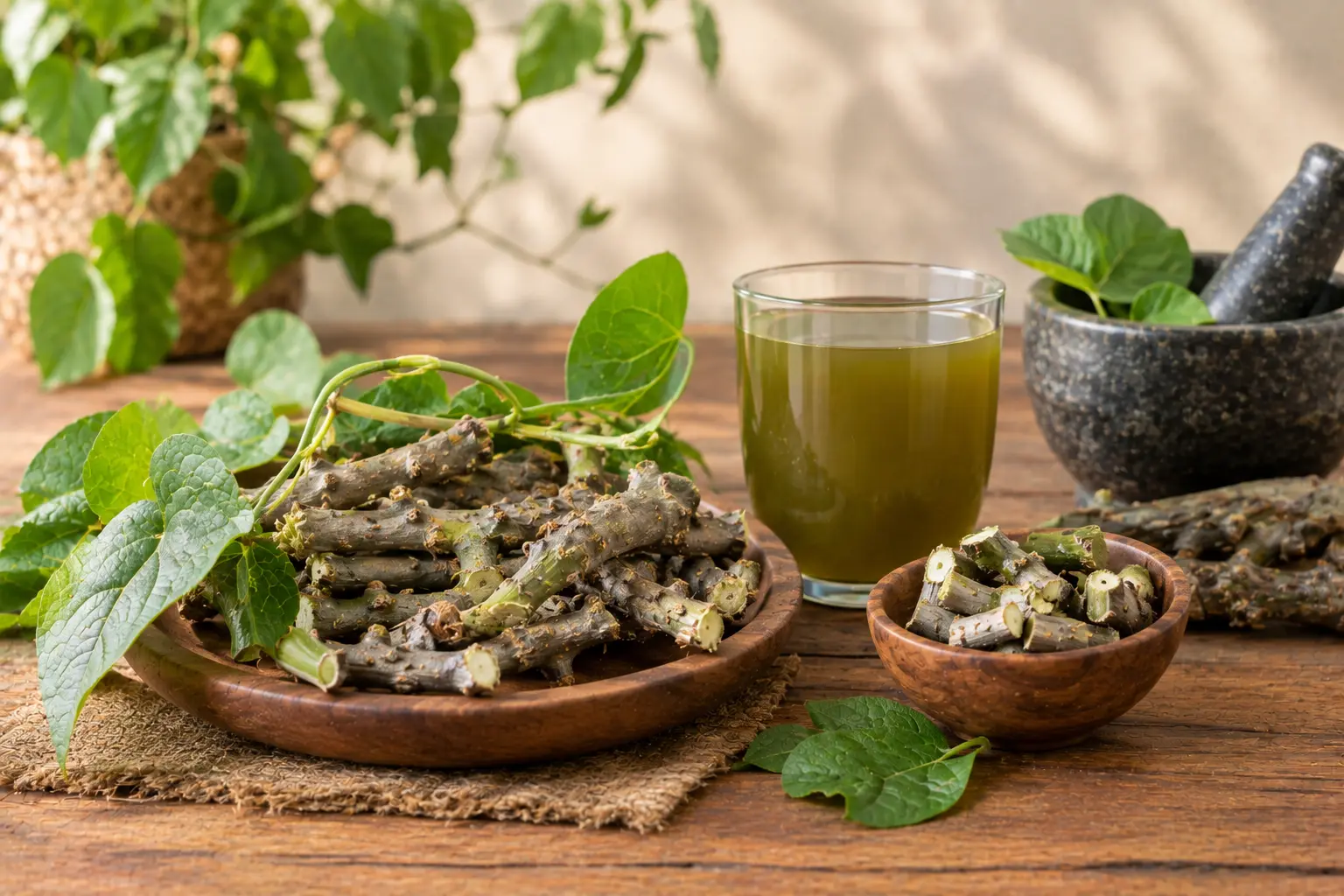
Guduchi
Guduchi, also known as Giloy, is another important ingredient in Kaishore Guggulu.
The botanical identity of Guduchi deserves particular attention. The Ministry of Ayush has emphasized the need for correct identification of Tinospora cordifolia because different species of Tinospora can have different safety profiles. The ministry specifically notes concerns regarding Tinospora crispa and potential hepatotoxicity.
This is a good example of why "herbal" should not be taken to mean that the identity or quality of an ingredient is unimportant.
Guggulu
Guggulu is the resinous ingredient that gives the formulation its name.
It has a long history of use in Ayurveda and contains compounds known as guggulsterones. Guggulu has been investigated in laboratory and human studies for several biological effects, although the evidence varies considerably depending on the condition and preparation being studied.
Research on guggulu itself should not be presented as research that proves the effectiveness of Kaishore Guggulu as a whole.
Shunthi
Shunthi, commonly called Sonth, is dried ginger. It is one of the three pungent ingredients included in the formulation.
Pippali
Pippali, or Choti Pippal, is long pepper. It is another traditional Ayurvedic spice included in Kaishore Guggulu.
Maricha
Maricha, commonly called Marich, is black pepper. Together with Shunthi and Pippali, it forms the group of pungent ingredients included in the formulation.
Vidanga
Vidanga, also called Vayavidanga, is the ninth ingredient. It is another traditional Ayurvedic herb used in classical formulations.
The complete formulation
Put simply, the formulation can be remembered as:
Triphala + Guduchi + Guggulu + Shunthi + Pippali + Maricha + Vidanga
And Triphala itself means:
Haritaki + Bibhitaki + Amalaki
Kaishore Guggulu and Joint Health
Joint health is often where people first encounter Kaishore Guggulu.
The traditional reasoning behind its use involves the formulation as a whole, rather than one ingredient acting as a standalone pain reliever. Its association with Vatarakta and inflammatory joint complaints is particularly strong.
But there is an important practical point here.
A painful joint is a symptom and not a diagnosis.
A swollen toe after a meal may have a very different cause from a knee that has gradually become painful over several years. Persistent swelling, warmth, recurring attacks, significant stiffness, or unexplained joint pain deserves proper medical evaluation.
Kaishore Guggulu should not be used as a substitute for finding out what is actually causing the problem.
Kaishore Guggulu and Skin Health
Skin conditions are another traditional area of use.
As noted earlier, CCRAS has completed a multicenter clinical study involving Kaishore Guggulu alongside Khadirarishta and Gandhakadya Malahar for Vicharchika, commonly associated with eczema.
The study is worth knowing about, but the treatment was a combination of interventions. It therefore cannot establish that Kaishore Guggulu alone treats eczema.
That distinction becomes especially important with skin problems because eczema, psoriasis, fungal infections, allergic reactions, and bacterial infections can sometimes look similar at first glance.
A persistent or worsening rash is better assessed than self-treated indefinitely with an herbal formulation.
How to Take Kaishore Guggulu
There is no single dosage that should be copied from one Kaishore Guggulu product to another.
The appropriate amount depends on the formulation, tablet strength, reason for use, and the practitioner overseeing the treatment.
The Ministry of Ayush's Standard Treatment Guidelines list Kaishora Guggulu in a particular Ayurvedic treatment context at 1 to 3 grams in divided doses. That recommendation belongs to that specific treatment guideline and should not be turned into a universal self-care dosage.
For a commercial tablet product, the sensible approach is straightforward:
Read the label of the exact product being used.
Follow the manufacturer's directions unless a qualified healthcare professional has given different instructions.
Do not increase the dose simply because the expected effect has not appeared quickly.
Tell your doctor or pharmacist about other medicines and supplements you take.
Stop and seek medical advice if you develop a significant or unexpected reaction.
How Long Can You Take Kaishore Guggulu?
There is no universally appropriate duration for Kaishore Guggulu.
Traditional Ayurvedic treatment plans may use formulations for particular periods, depending on the condition they address. A commercial product may also provide its directions.
Long-term use is a different matter from occasional use. If you take the formulation regularly for weeks or months, especially alongside prescription medication, a qualified healthcare professional should review your continued use.
The reason for taking it is just as important as the number of tablets you take.
Does Kaishore Guggulu Have Side Effects?
The fact that a formulation contains traditional herbs does not make it automatically free of side effects.
Guggulu, one of the principal ingredients, has been associated with headache, mild nausea, belching, hiccups, loose stools, and skin reactions. Memorial Sloan Kettering also notes that guggulu may interact with medicines metabolized through CYP3A4 based on laboratory evidence.
There have also been case reports involving elevated liver enzymes and liver injury with some multi-ingredient products containing guggul or guggul-related extracts. These reports do not establish that Kaishore Guggulu itself causes liver injury, but they are one reason not to assume that herbal products are risk-free.
If a new rash, persistent gastrointestinal symptoms, unusual bleeding, jaundice, severe weakness, or another concerning symptom appears after starting an herbal product, medical advice should be sought.
Who Should Be Careful With Kaishore Guggulu?
A conversation with a healthcare professional is particularly important if you:
Take prescription or over-the-counter medicines
Have liver or kidney disease
Have a chronic medical condition
Are pregnant or breastfeeding
Are preparing for surgery
Take several herbal or Ayurvedic products
Have diagnosed gout or another long-term inflammatory condition
Have a persistent or unexplained skin condition
Are considering giving the product to a child
It is also worth mentioning Ayurvedic medicines whenever a doctor or pharmacist asks about supplements and other products being used.
That information can help identify possible interactions that might otherwise be missed.
Kaishore Guggulu vs Other Guggulu Formulations
The word guggulu may appear on the labels of several Ayurvedic formulations, but that does not mean they are all made for the same purpose. Each formulation combines guggulu with different herbs and has its own traditional place in Ayurveda.
Kaishore Guggulu, for example, is a specific formulation traditionally associated with Vatarakta, joint and inflammatory complaints, and certain skin conditions. Other guggulu formulations have different combinations of ingredients and are traditionally used in different contexts.
So, choosing between them is less about finding the "strongest" guggulu and more about understanding which formulation is right for you.
If you have a specific health condition, ongoing symptoms, or take prescription medicines, it is always better to speak with a qualified healthcare professional or Ayurvedic practitioner before starting a new herbal formulation. They can help you understand whether it is suitable for your particular situation.
You can explore our range of guggul products to see the different formulations and Ayurvedic brands available at The Desi Food.
If you already know what you are looking for and want to explore Kaishore Guggulu products, we have picked a few options below from different Ayurvedic brands.


What Should You Check Before Buying Kaishore Guggulu?
A little label-reading goes a long way with multi-ingredient Ayurvedic products.
Check the complete ingredient list
The product should clearly state what is included. Do not rely only on the name of the formulation.
For Kaishore Guggulu, the complete traditional ingredient profile includes the nine components listed earlier in this article.
Check the directions
Tablet strength and recommended serving sizes can differ between products.
Check the manufacturer
Look for clear information about the manufacturer, batch details, expiry date, and storage instructions.
Check whether the product is meant to be used under supervision
Some manufacturers specifically advise medical supervision. Patanjali's current Divya Kaishore Guggul, for example, carries that instruction.
Think about medicines already being taken
This is particularly important with multi-herb formulations. Guggulu, for example, has potential drug-interaction considerations.
If prescription medicines are already part of the routine, checking with a doctor or pharmacist before adding Kaishore Guggulu is a sensible step.
Understanding Kaishore Guggulu in Context
Kaishore Guggulu becomes much easier to understand once the formulation is separated from the long list of claims that often surrounds it online.
At its core, it is a nine-ingredient Ayurvedic formulation built around Triphala, Guduchi, guggulu, three pungent herbs, and Vidanga. Its traditional use is particularly connected with Vatarakta and certain joint, inflammatory, and skin-related conditions.
There is genuine research on the formulation, especially in relation to gout. CCRAS has documented clinical studies as well as experimental work involving hyperuricemia and gout models. But the research is not broad enough to treat every traditional or commercial health claim as established medical fact.
That is perhaps the most useful way to approach Kaishore Guggulu. Look at the complete formulation, not just one attractive ingredient. Look at the evidence for the actual formulation, not evidence borrowed from unrelated herbs. And when a product is being used alongside medication or for a diagnosed condition, bring a healthcare professional into the conversation.